Satellite navigation is the primary position and timing source for most unmanned platforms. When that signal degrades, the consequence is not simply a position error: flight controllers lose attitude reference, mission planners lose geofence integrity, and timing-dependent payloads drift out of synchronisation.
Two threat classes dominate. Jamming raises the noise floor across the L-band until the receiver can no longer acquire or track satellites. Spoofing is subtler — a counterfeit signal is broadcast with plausible power and correct-looking timing, causing the receiver to compute a position that is wrong yet internally consistent. A platform under spoofing may report a stable track while physically drifting off course.
For defence, inspection, agricultural and logistics operators, both scenarios are routine rather than theoretical, particularly near critical infrastructure and along contested borders.
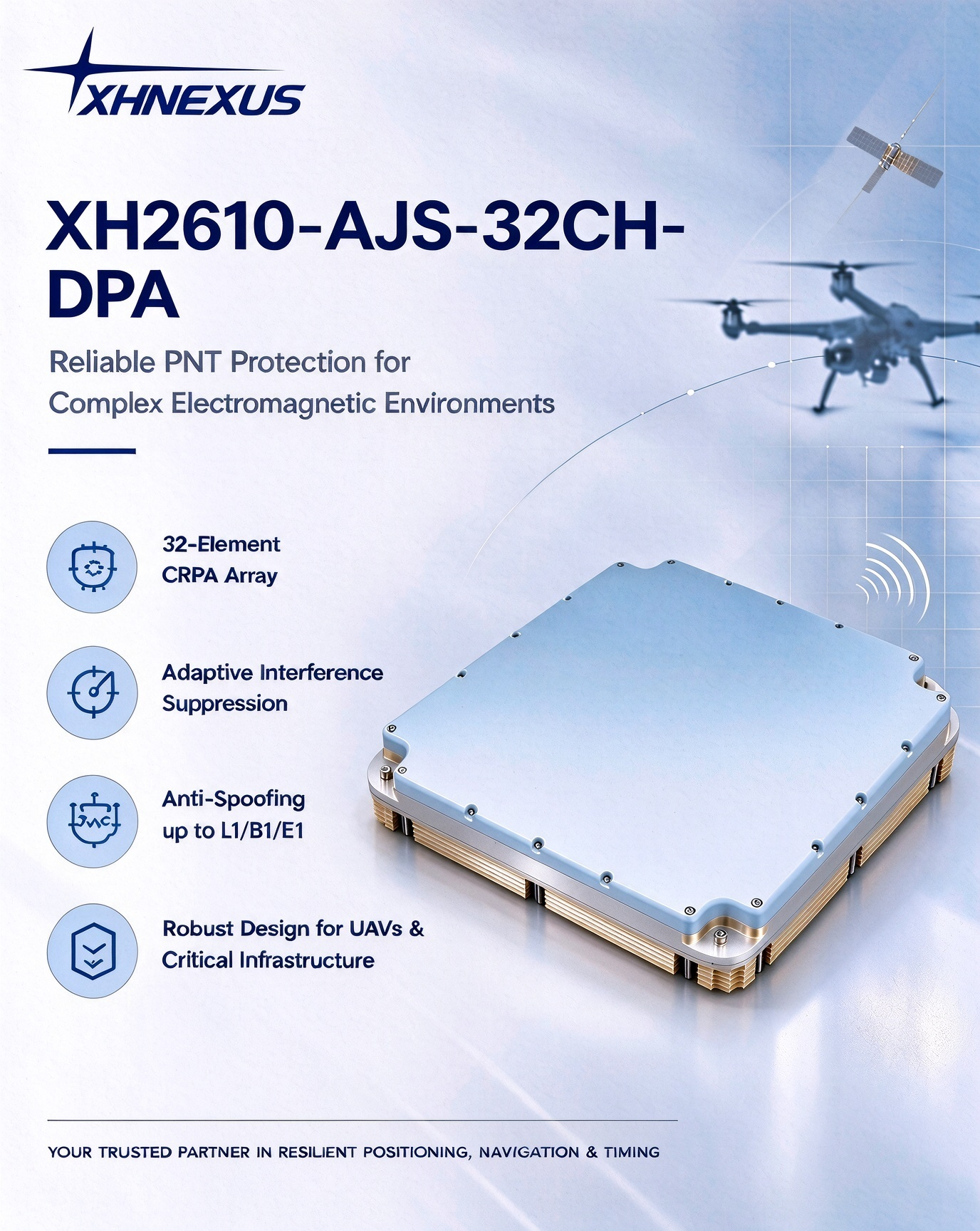
The XH2610-AJS-32CH-DPA is an integrated anti-jamming and anti-spoofing terminal. It combines a 32-element antenna array, the anti-jamming processing module and a GNSS receiver in a single housing, so integration requires no separate antenna farm, cable harness or external processor.
It operates on BDS-B1i, GPS-L1 and Galileo E1, and outputs cleaned RF at 1561.098 MHz and 1575.42 MHz into the host receiver at -70 to -60 dBm into 50 ohms.
Single-source suppression depth is ≥120 dBc. That figure degrades predictably as the electromagnetic environment becomes more crowded:
Suppression holds across narrowband, broadband, pulse, swept, Gaussian and mixed jamming — the profiles produced by both commercial jammers and improvised SDR-based sources. Three quarters of real deployments sit in the 7-to-15 jammer band, where rejection stays above 95 dBc.
Residual spoofing signal CNO is held at ≤20 dB, leaving enough margin for the authentication layer to discriminate. Combined with 0°–360° azimuth and -90°–+90° elevation coverage, there is no directional blind spot an attacker can exploit by approaching from above or below the platform.
The flat 54 mm profile suits roof and mast mounting where vertical clearance is limited.
XH-Nexus carries three further terminals in this family. The evaluation order is usually threat density first, then size and power:
The 32-channel terminal is the correct selection when the threat is multi-source and sustained, or when PNT integrity is safety-critical rather than convenient.
Send your platform type, mounting envelope and the interference environment you expect to operate in. We will confirm whether the 32-channel terminal is the right fit, or whether a smaller array meets the requirement at lower mass and cost.
Contact our engineering team →